
How to build a book
Dispatches and writing advice from a midlist author misfiring in the gig economy.

“A writer is someone who counts words,” suggested John Braine, author of 1957 classic Room At The Top. But producing 60,000 to 80,000 words, the length of most books, can seem very daunting. My method is to divide a book into chapters and treat each chapter as an essay or feature article. That way you are focusing on completing one bit of work at a time rather than trying to force your way to 60,000 words plus.
If your book has say 20 chapters and each chapter is 2500 words long then that’s 50,000 words already. What I then do is go back to each chapter, sub-edit it and then look for places where I could add in more words. Was there something mentioned where I could expand the theme or add in more detail? A few hundred words added to each chapter soon add up.
Most writers aren’t very good at carpentry or building walls, but as a craft writing is quite similar; building from the bottom up, adding to the work day by day and chiselling away or adding in filler until you get a perfect finish.
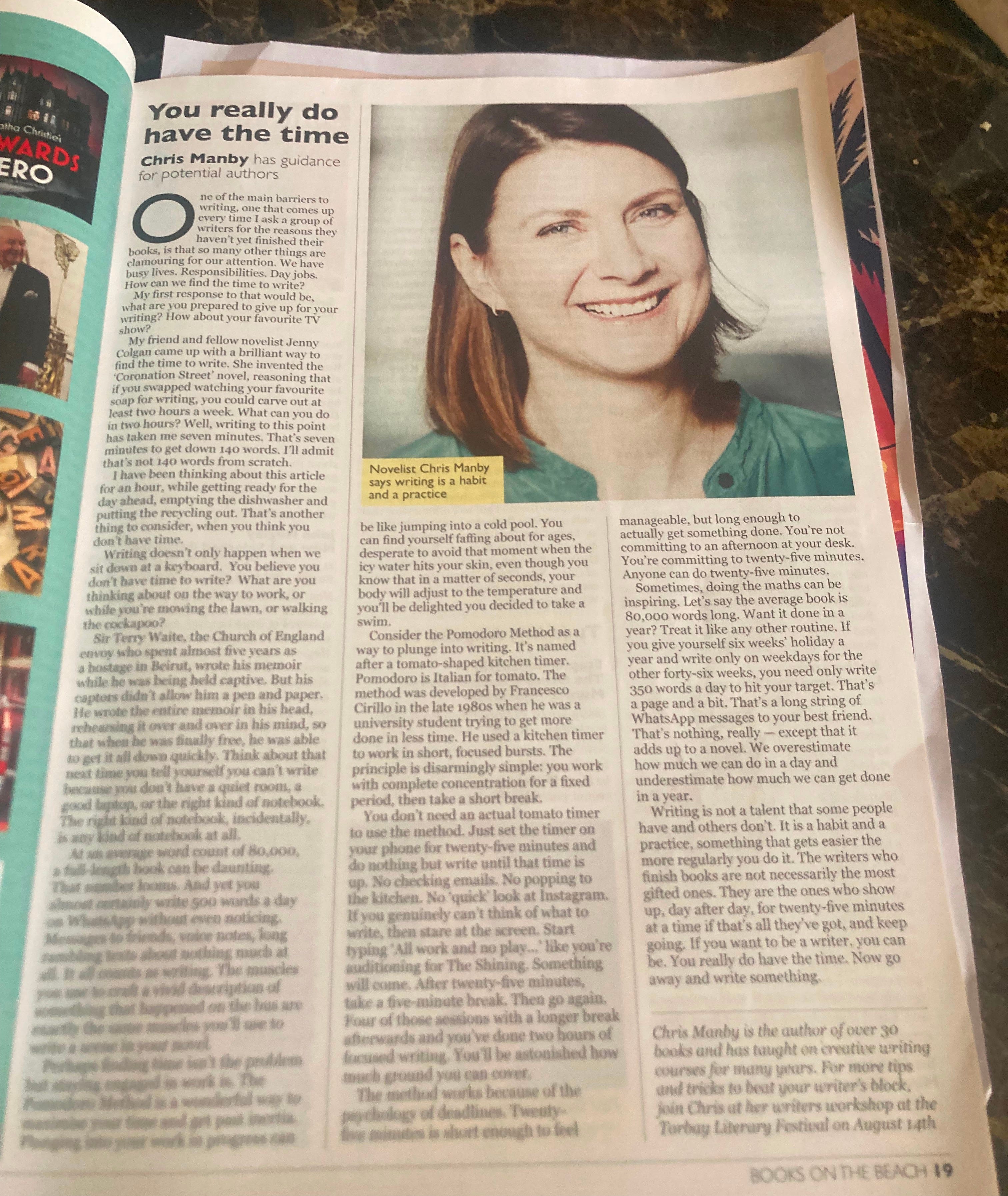
I recently came across an excellent article in Books on the Beach, the Torbay Literary Festival magazine, written by author and creative writing coach Chris Manby. She writes: “One of the main barriers to writing, one that comes up every time I ask a group of writers for the reasons why they haven’t yet finished their books, is that so many other things are clamouring for their attention. We have busy lives. Responsibilities. Day jobs. How can we find the time to write?”
But you don’t need to spend all day sweating at the typeface, small chunks of writing can be very effective. Manby mentions one tip from author Jenny Colgan, which is to give up watching your favourite TV soap opera. That way you could be spending two hours or more a week on writing.
Timer and space
Another method she suggests is the Pomodoro Method, named after a kitchen timer and suitable mainly, I imagine, for middle-class writers with kitchen islands. It was invented by Francesco Cirollo in the 1980s. Using the Pomodoro kitchen timer you work in 25 minute bursts, because this seems like only a short time to work and the human body responds well to short deadlines. Four sessions and you’ve done nearly two hours of writing.
At this point we might mention writers’ block, indeed I used to live in one in Westbourne Park, a council tower block that was full of asbestos. The important thing is to just get a sentence down. Write one line and something else will follow and anyway, in 25 minutes you can have a cup of tea.
Chris Manby points out that if you can write 350 words a day in your 25-minute session, then in a year, assuming six weeks’ holiday, you have reached around 80,000 words. Ernest Hemingway famously only wrote 500 words a day before going out to the bar or to worry some big game. Manby adds that, “The writers who finish books are not necessarily the most gifted ones. They are the ones who show up, day after day for 25 minutes at a time if that’s all they've got and keep going. If you want to be a writer you can be.”
Sound advice. Time to go now. I’ve got a book to finish.
Pete May’s most recent book is Massive: The Miracle of Prague, published by Biteback. He is also the author of the memoir What Are Words Worth?